
Accelerate December 2026

Withers Admin • November 26, 2026
Can you really switch off this summer?
You've wrapped up the last jobs, switched on your out-of-office and headed off for a well-earned holiday break

But how long before you’re sneaking a look at your emails or taking a quick customer call?


Switching off is easier said than done. But sometimes a little distance from your business is exactly what you need.


SET YOURSELF UP FOR A PROPER BREAK

  • Let people know you’re away. Tell customers when you’ll be back and who to contact if something urgent comes up.
  • Leave someone in charge. If the business is staying open, make sure your team knows what they can handle without you.
  • Define an emergency. Decide what genuinely warrants interrupting your holiday. Most things can wait.
  • Put your phone to work. Turn off work notifications, try your phone’s ‘Do Not Disturb’ mode, or set specific times to check messages if you absolutely need to.
  • Try being a little less available You know the feeling; you’re at the beach with the kids, your phone pings, and suddenly you’re thinking about work again.  Try leaving your phone in a drawer, or conveniently ‘forget’ it when you head out for a walk. Even half an hour without it is a good start.

Give your mind room to wander

Some of the best ideas arrive in the shower, out walking or over your morning coffee when your mind has a chance to drift rather than focus on the next job or deadline.


So, rather than filling your holiday with business podcasts or planning for 2027, give yourself time to enjoy the things you love. Get out into nature, read a good book, spend time with family, or simply laze around without feeling guilty.


And if a great idea pops into your head, jot it down and leave it for January.



Election impact on SMEs

At the time of going to press, the preliminary outcome of the election count has left everyone waiting. With 400,000 special votes not being finalised until 27 November, the

current slim majority held by the National-led coalition could be overturned, should the newly elected Opportunity Party, with seven MPs, decide to work with Labour to form the

next government.


This makes forward planning difficult as policy difference, such as Labour’s proposed capital gains tax and its pledge to repeal Investment Boost remain up in the air, and coalition negotiations could shape any final package.


Until the picture becomes clearer, the sensible thing to do would be to keep on top of and tidy up as much as you can before the Christmas break, make any urgent decisions on current rules, keep records tidy, and keep possible outcomes in mind when considering strategic decisions.

When cash flow goes sideways
A late payment, unexpected bill or delayed project can throw even the best cash flow plans off course, particularly over summer when wages, tax and other expenses still need paying. So, what can you do when your cash flow takes an unexpected hit?

Work out where you stand

Start by looking at what’s coming in, what’s going out and when. A six-to-eight-week forecast will help you see exactly where the gaps are and how much you’ll need to cover them.


Is it a temporary timing issue, or are your expenses consistently exceeding income? The answer will help determine your next move.


Make sure you’ve allowed for upcoming tax obligations, particularly January’s GST and provisional tax payments.


Prevent one problem from becoming another

An overdue customer payment can quickly affect your ability to pay suppliers, staff and other bills, but there are things you can do to ease the pressure. Could you negotiate longer payment terms with a supplier? Invoice for work completed rather than waiting until a project finishes? Put off a non-essential purchase?


And don’t assume that taking on more work will solve the problem. If you need to pay for materials or labour upfront, additional sales could actually make your short-term cash flow worse.


OPTIONS WORTH LOOKING AT

• Tax pooling: This can offer more flexibility

around eligible provisional tax payments.


• Inland Revenue instalment arrangements:

You may be able to spread outstanding tax

payments over time, although interest and

some penalties can still apply.


• Provisional tax adjustments: If your

expected annual profit has dropped, it may

be worth reviewing your provisional tax

obligations.


• Short-term finance: An overdraft or other

lending facility could help bridge a temporary

gap, provided the repayments are affordable.


Are subscriptions quietly eating your profits?
Remember signing up for that free trial six months ago? Or the software you needed for a project that's now wrapped up?

Monthly subscriptions tend to slip under the radar, especially when the individual amounts seem insignificant. But a few unused apps, overlapping services and automatic renewals

can easily add hundreds, if not thousands, to your annual business expenses.


Give your subscriptions a quick audit

  1. Check the last three months of bank and credit card transactions for recurring payments.
  2. Multiply monthly charges by 12 to see what they’re costing annually.
  3. Look for duplicated services, unused licences and price increases.
  4. Check cancellation terms before your next annual renewal.

JANUARY'S TAX SQUEEZE
While you’re enjoying a day on the water or a lazy afternoon at home, the last thing you want to think about is tax. But January brings a hefty round of GST, provisional tax and other payments you need to be aware of.
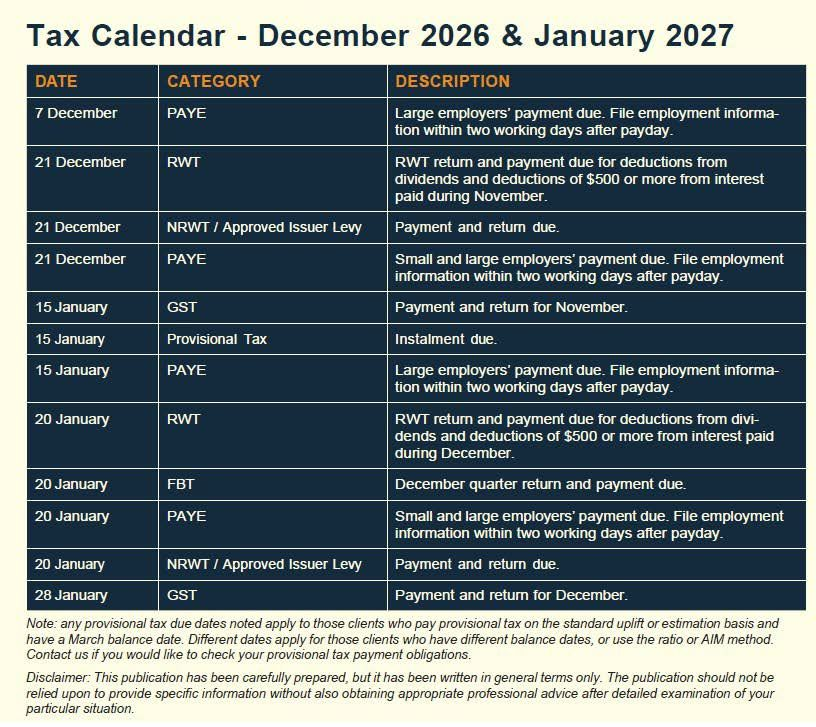
  • Know what’s coming: Check your upcoming tax obligations in myIR, with your accountant, or use our tax calendar.
  • Plan for the summer slowdown: Allow for both December and January tax obligations, particularly if your income slows over the summer break.
  • Make payments easy: Schedule payments in advance so you don’t have to think about them while you’re away.
  • Spot a shortfall early: If you’re unlikely to have enough set aside, talk to us before Christmas about your options.
When cash flow goes sideways
A late payment, unexpected bill or delayed project can throw even the best cash flow plans off course, particularly over summer when wages, tax and other expenses still need paying. So, what can you do when your cash flow takes an unexpected hit?

Work out where you stand

Start by looking at what’s coming in, what’s going out and when. A six-to-eight-week forecast will help you see exactly where the gaps are and how much you’ll need to cover them.


Is it a temporary timing issue, or are your expenses consistently exceeding income? The answer will help determine your next move.


Make sure you’ve allowed for upcoming tax obligations, particularly January’s GST and provisional tax payments.


Prevent one problem from becoming another

An overdue customer payment can quickly affect your ability to pay suppliers, staff and other bills, but there are things you can do to ease the pressure.  Could you negotiate longer payment terms with a supplier? Invoice for work completed rather than waiting until a project finishes?

Put off a non-essential purchase? 


And don’t assume that taking on more work will solve the problem. If you need to pay for materials or labour upfront, additional sales could actually make your short-term cash flow worse.

By Withers Admin • October 19, 2026
Start planning your Christmas spending now
By Withers Admin • June 4, 2026
The Farming Issue 
By Withers Admin • May 10, 2026
Invitation to meet the team on Wednesday 27th May 2026 from 5pm - 6.30pm. At 21 Neville Street, Warkworth. Beverages & Nibbles provided.
By Withers Admin • April 20, 2026
As we step into a new financial year, we’re mindful that not everyone has had a smooth start to 2026. Extreme weather has created uncertainty for parts of the country and reminded many businesses just how quickly conditions can change. The global situation has intensified that. While we can’t control everything that happens around us, we can make sure we’re prepared for shifts when they come. That starts with a clear understanding of your finances, staying on top of compliance, and planning ahead rather than reacting under pressure. In this issue, we cover three key employment and tax changes you need to know (and two to keep an eye on), how to get more value from your accountant, and the signs that business confidence in New Zealand is steadily improving. Three key changes for employers in 2026 A few recent and upcoming changes may impact your payroll, pricing, and employer obligations.
A quick check now sets you up for a smoother year ahead. 1. Minimum wage is increasing From 1 April 2026, the adult minimum wage rises to $23.95/hr (from $23.50). Starting-out and training wages increase to $19.16/hr (from $18.80). Make sure your payroll and employment agreements reflect the new rates. Higher wages can affect your margins, so now’s a good time to reassess your pricing structure. Speak to your accountant if you need help understanding what these changes mean for your bottom line. 2. KiwiSaver contribution rates go up Also starting 1 April 2026 , the default KiwiSaver contribution rate increases from 3% to 3.5% for both employees and employers. Note employees are able to apply for temporary rate reductions to continue contributing at the 3% rate, in which case employers may also opt to match this employer contribution rate. Employer contributions will also now apply to KiwiSaver members aged 16 and 17. This is part of a phased retirement-savings policy change, with a further rise to 4% planned for 2028. Review your payroll processes to make sure your contributions are applied correctly. 3. Fringe Benefit Tax updates continue Updated FBT thresholds and rate structures came into effect on 1 April 2025, with further refinements expected to be rolled out in 2026. Concessions such as equalisation of FBT and PAYE on unclassified benefits give you more flexibility in how FBT is calculated and means the tax rate applied better reflects what your employees earn. Inland Revenue has also clarified how certain employee gift cards are taxed. Open-loop cards (such as prepaid cards that can be used almost anywhere) are generally treated like cash and taxed under PAYE, while retailer-specific cards usually still fall under FBT. If you provide vouchers or gift cards as staff rewards, it’s worth checking they’re being taxed under the right rules. Things to watch Keep an eye out for these two changes on the horizon. Shareholder loans If you regularly draw funds from your company through a shareholder loan, this is one to watch. While not yet law, Inland Revenue has recently consulted on proposals to treat new shareholder loans as taxable dividends if they are not repaid within a set timeframe. Surcharge ban The Retail Payment System Amendment Bill has passed its first reading and is expected to take effect by May 2026. If enacted, it will ban most in-store surcharges on EFTPOS, Visa, and Mastercard transactions. We’ll keep you updated as details are finalised .
By Withers Admin • December 7, 2025
Accelerate December 2025 As 2025 draws to a close, we’d like to thank you for your continued support this year. Our team is taking a well-earned break from Friday 19th December and will return to the office on Monday 12th January 2026. But before you switch on the out-of-office, take a moment to get your business ready for the holiday season. In this issue, we’ve included tips to help you manage the summer cash flow crunch, a guide on what you can (and can’t) claim back for festive spending, advice for compliant Christmas promotions, and a timely reminder to look after your team’s mental health as the year wraps up. Wishing you a safe, sunny, and successful holiday season! How to survive the Christmas cash flow crunch While retailers race through their busiest time of year, not every business benefits from the Christmas rush. Many service-based, wholesale, or manufacturing businesses might even face a sharp decline in orders just when holiday pay, bonuses, and annual shutdowns see expenses rise. 1. Forecast to February Projecting your income and expenses well into the new year helps you spot potential shortfalls and take action before they become problems. 2. Invoice early, follow up now Send invoices before your shutdown period and chase outstanding debts while clients are still around. 3. Prioritise essential spending Identify what expenses are necessary and what can wait until revenue picks back up. 4. Prepare for January’s tax obligations The 15 January due dates for PAYE, GST, and provisional tax can feel like a Grinchy surprise. Set aside funds now to avoid starting the new year under pressure. Worried about the summer squeeze If this season feels tight, get in touch.  Our financial advisors can help you plan ahead, manage your cash flow, and explore IRD instalment options to lighten the load. Tis the season for giving... but what can you claim back Gifts, bonuses, parties, and more: here’s a brief breakdown of what you can and can’t claim this festive season. Employee gifts Gifts that are not subject to the entertainment tax rules (vouchers, hampers, flowers) are fully deductible and exempt from Fringe Benefit Tax (FBT) if they cost less than $300 per employee per quarter, and the total for all staff stays below $22,500 a year. However, gifts that do fall under the entertainment tax rules, like food hampers or wine, or taking your team to a show or event, are 50% deductible, and not liable for FBT. Cash bonuses Bonuses are classed as income, so PAYE and other payroll taxes apply. These “lump sum” payments are taxed at a flat rate based on your employee’s income bracket. Client gifts Food, drink, or entertainment gifts are 50% deductible. Other gifts (flowers, movie tickets, a book) are 100% deductible Workplace events Christmas parties, client dinners, or team drinks are 50% deductible, while morning teas, office lunches, and charitable donations are fully deductible.
By Withers Admin • December 4, 2023
Accelerate - December 2023
By Withers Admin • December 4, 2023
Accelerate August 2023 
By accelerateonline • June 12, 2023
Inland Revenue have recently announced this year’s livestock Herd Scheme Values and we think this is a great opportunity to update you on the latest movements. The Herd Scheme Values are the National Average Market Values, determined by a process involving a review of the livestock market as at 30 April.
By accelerateonline • June 12, 2023
The values for Dairy this year have seen a fall in values across all female classes, but increases across all male classes. The fall in R1 heifer values can be attributed to the prohibition of live export by sea commencing from 30 April 2023. For the first time the National Average Market Value for R1 Heifers is less than the National Standard Cost of breeding and rearing an R1 Heifer.
By accelerateonline • June 12, 2023
In contrast to Dairy values Beef values have increased on average 9% and are almost at record values for all classes.
More Posts